Partial fills and remaining-order exposure
Keep filled quantity, remaining orders and cancellation evidence distinct before measuring account exposure.
The proposal is not the position
A requested quantity and a filled quantity can differ. Preserve the instruction, actual order status and each fill rather than assigning the proposed entry to every requested unit. Remaining quantity can still matter to the account if an order is working, while a pending request is not already an executed position. These are different observations. The relevant account record needs identifiers, clocks and statuses. A later chart or platform message cannot establish the price or quantity actually accepted by the broker.
A cancellation needs confirmation
A request to cancel does not itself establish that remaining quantity can no longer fill. Keep the request, acknowledgement and any subsequent events separately. Do not infer a completed account state from a publisher withdrawing an idea. In a real review, link the order evidence to the same observation interval as the risk budget. If the state is unknown, preserve an unresolved remaining-order question instead of describing the account as either fully exposed or safely flat. This publication submits no orders and certifies no broker event.
Recalculate with the supported units
Risk arithmetic should use quantities and prices belonging to the actual measurement being made. A planned full-order reference can be retained as a proposal, while filled exposure is a separate calculation with documented units and costs. Keep financing, working orders and a possible later fill outside any claim of a completed safe account. Do not silently cancel or resize native production logic to make a consumer example fit. The worksheet's cash-funded long-share contract is a fixed hypothetical lane, not a universal partial-fill implementation.
State the next evidence object
The useful result names which quantity is known and which account event remains missing. A consumer can reproduce a proposed budget while execution remains unverified. A model performance summary does not supply the order journal. Statistical validation also needs its own independent data; tests that catch a quantity bug are not new market observations. Keep source and scenario exports labelled accordingly. The article teaches record separation and avoids personal trade size, promised fill, broker-safety or financial-return conclusions from an incomplete order state.
Completed invented account case
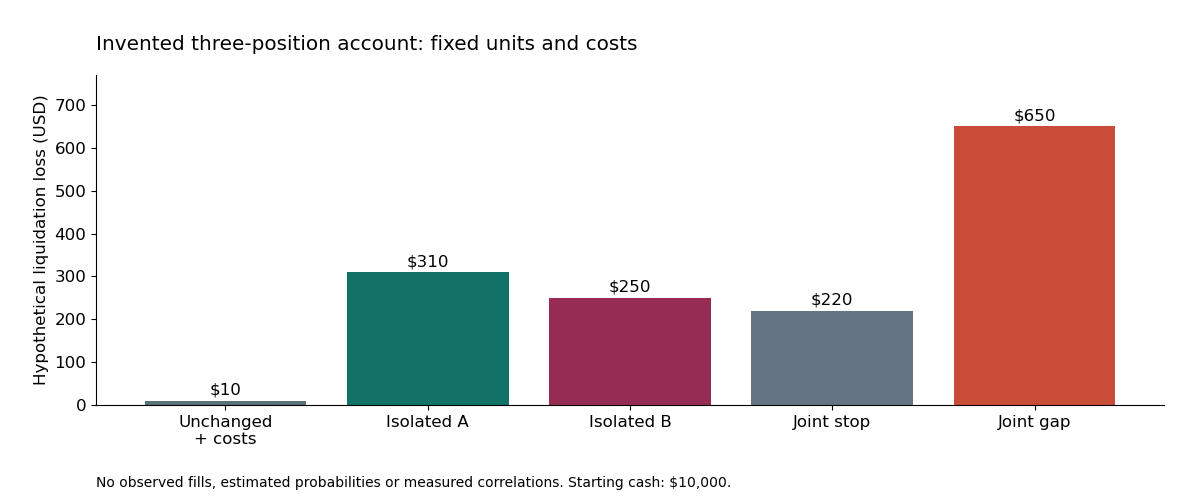
Fictional case: a proposal requests fifty units, but only twenty are documented as filled. Thirty remain in an unconfirmed cancellation state. The reviewer retains the fifty-unit proposal separately from twenty-unit executed exposure and the thirty-unit open question. There are no actual order prices or account transactions in this case. The finding is partial quantity known, remaining state unresolved. It does not claim all fifty filled, that cancellation succeeded, or that the account was protected merely because the intended stop budget looked small.
| Object | Record | Bounded finding |
|---|---|---|
| Proposal | Invented 50 units | Not all executed |
| Documented fills | 20 in fictional record | Separate quantity |
| Remaining 30 | Cancellation unconfirmed | Exposure question retained |
Primary references and scope
Expanded source review: 13 October 2026. Documentation supports the stated mechanism, not a tested account, hypothetical fill or provider outcome.