Risk Budget, Margin Budget and Liquidity Reserve Are Different
Separate planned loss from account funding requirements and adverse execution scenarios before deciding whether a position is affordable.
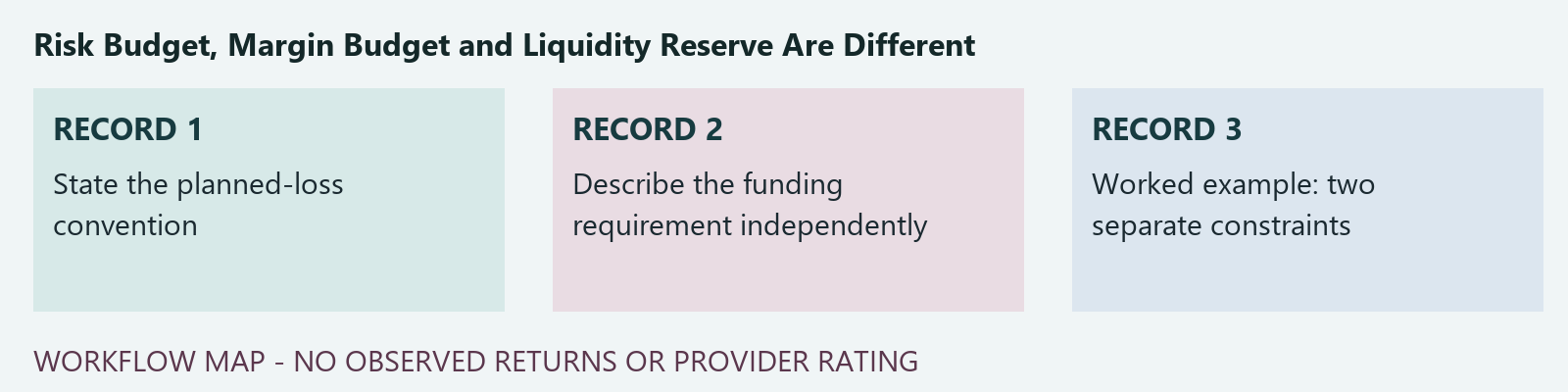
State the planned-loss convention
Define the instrument, position quantity, entry reference, stop assumption and costs included in a planned loss. For a simple linear exposure, quantity times price distance can describe that planning scenario. It is not a universal loss bound. Gaps, unavailable execution and different contract structures require separate treatment. Do not assume a stop will execute at its trigger or translate a conviction label directly into an account risk percentage. The risk budget is an input under an explicit convention, not a promise.
Describe the funding requirement independently
Record initial margin, maintenance requirements, broker add-ons and collateral rules from the actual product and account. CME documentation provides primary futures margin terminology; current exchange and broker terms supply the numbers for a real position. Margin is not the same object as stop-distance risk, and a low funding requirement does not imply a small economic exposure. Keep the account's cash and eligible collateral separate so a nominal account value is not mistaken for immediately available funding.
Worked example: two separate constraints
Invent an account with 10,000 units of available cash, a planned-loss budget of 200 and a fictional contract requiring 3,000 of initial margin. Suppose one contract has 150 units of gross planned stop loss. A planned-loss-only calculation permits one contract, while the margin-only arithmetic permits three before reserves and other positions. Neither constraint should override the other. The single-contract plan still needs costs, gap scenarios and funding buffers. This fictional example is not a recommendation, current contract specification or statement that 150 is a maximum possible loss.
Retain a liquidity reserve question
Identify what cash remains after requirements for all simultaneous positions, charges and foreseeable funding changes under declared scenarios. Do not count a pending withdrawal or illiquid collateral as settled cash. Specify which shocks are illustrative rather than observed risk forecasts. A reserve amount cannot be inferred from a general article or a provider's win rate. The purpose is to expose account constraints that a one-position calculator omits, not to invent a universally sufficient safety buffer.
Aggregate the same adverse event
Positions can share currency, sector, venue, collateral or execution risk even when their tickers differ. Write a common adverse scenario and sum its assumed cash effects without pretending correlation is stable or that every position necessarily loses the same amount. Keep stop-based scenarios distinct from gap and forced-close scenarios. SEC order guidance helps explain why intended exits are not guaranteed fills. A separate stress worksheet should disclose its assumptions and not convert a plausible scenario into a calibrated loss probability.
Record the governing constraints
Publish the planned-loss budget, funding requirement, reserve assumptions, simultaneous exposures and unresolved product terms. If a required input is missing, leave the position eligibility question unanswered rather than forcing a numeric size. Retain the time and source of each actual requirement because terms can change. This chapter offers an account-control framework, not personalised sizing advice or proof of a provider's risk discipline. A useful risk decision explains which constraint binds and which uncertainty remains, instead of treating one neat calculator output as the whole account picture.
Decision record
| Question | Record to retain | Decision boundary |
|---|---|---|
| Planned loss | Quantity, distance and explicit cost convention | Stop-based arithmetic is not maximum possible loss |
| Margin | Current product and broker funding terms | Collateral requirement is not trading risk |
| Reserve | Settled cash and stated adverse assumptions | Account equity need not be immediately liquid |
| Overlap | Joint exposures under the same scenario | Different symbols can share one funding shock |
Blank working record
The worksheet contains column headings only. Enter your own dated observations, keep absent evidence marked unknown, and do not treat the file as certification.
 Download worksheet (CSV)
Primary references
These documents support mechanisms and source definitions, not a tested trading result or a recommendation. Accessed 9 October 2026. The decision workflow and invented examples above are editorial exercises.
Keep reading
Publication methodology | Working glossary | Source and correction policy
One cash lane, separate other contracts
The new calculator rejects a three-position packet whose entry plus additional costs exceeds its cash-funded account. It does not quote margin or use that funding check as a guarantee about loss. A leveraged account would need different collateral, financing, liquidation and product rules. CME's mechanism explanation is a source reference, not the reader's current broker requirement. The example can therefore answer a cash arithmetic question while leaving margin eligibility and potential losses under a different contract unresolved.
A completed source boundary
An invented reviewer can reproduce 8,410 funding against a 10,000 cash base and the assumed 650 joint loss. There is no borrowing or broker agreement in the packet. The proper finding is funded under the example's cash contract, not eligible under a live margin schedule. A later changed requirement or actual market exit would require a new record. The article keeps that distinction rather than declaring a generic percentage or funding balance sufficient for every position type.