Scenario probabilities and expected-loss claims
Keep a loss magnitude separate from its unknown likelihood before averaging invented stress rows.
A row is not a probability
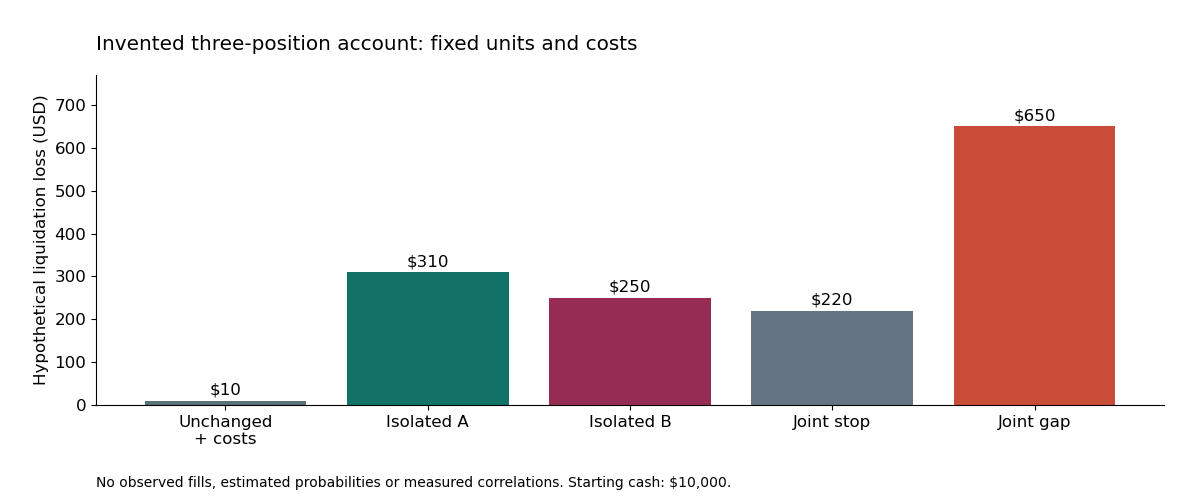
A scenario table can contain five, fifty or hundreds of rows without defining how often those states occur. Equal row counts do not automatically imply equal probabilities. A stress magnitude is a specified input, not an observed frequency. The workbook intentionally assigns no likelihood to unchanged, isolated or joint exits. Averaging its rows would produce an arithmetic mean of selected illustrations, not a measured expected account loss. Preserve that limitation before a precise average is repeated in a report or search snippet.
Expected loss needs an additional model
To call a weighted quantity expected loss, the weights and outcome states need a defensible definition and source. A historical sample, forecast model and user-selected stress probabilities have different evidence classes. Do not invent weights from intuition merely to complete a template. A real account outcome also needs the relevant execution and cost policy. The publication supplies no fitted distribution, loss-frequency record or strategy evaluation. It provides an exact conditional cash calculation and an explicit source request for any stronger statistical interpretation.
Useful stress without a frequency claim
An assumption can still reveal that a joint price move creates a larger loss than the planned reference. That observation does not require presenting the move as likely, rare or exhaustive. Keep position quantities, account base and costs fixed so the consequence is interpretable. Do not market a selected maximum row as the maximum possible future loss. The permitted tool lane excludes borrowing and derivatives and has no price path; even within its long-share exercise, unlisted states remain possible assumptions rather than ruled-out futures.
Final assurance boundary
The completed consumer finding names a scenario result and states that probability, expected loss and actual liquidity are untested. A well-labelled figure or exact Decimal fixture does not change that status. Software tests verify formulas and invalid inputs; they do not establish a trading edge. The workbench's assurance field lets a reader separate measured records from stress assumptions. A promotional product claim should not borrow the workbook's numerical precision to imply independently audited account risk or a personally appropriate capital allocation.
Completed invented account case
Fictional case: an author gives each of the five workbook rows a 20% weight solely because five rows are visible. The source has no frequency or forecasting model, so the resulting expected-loss claim is not supported. Each conditional cash row remains reproducible. The completed correction is to retain the five scenarios without weights, not invent probabilities or discard the useful illustration. The example contains no real account, fitted model or observed crisis sample.
| Object | Record | Bounded finding |
|---|---|---|
| Five visible rows | Selected assumptions | Not five equally likely states |
| Proposed weights | Invented 20% each | No source basis |
| Supported output | Conditional cash results | Expected loss unresolved |
Primary references and scope
Expanded source review: 13 October 2026. Documentation supports the stated mechanism, not a tested account, hypothetical fill or provider outcome.