Three-position cash stress workbook
A completed invented USD long-share exercise: fixed quantities, explicit costs and five alternative liquidations.
The cash contract comes first
This is a completed invented specimen, not a real portfolio, recommendation or provider test. A, B and C are whole long shares denominated in USD, paid from an initial 10,000 cash base. There is no borrowing, short sale, derivative multiplier, currency conversion or intervening deposit. Each scenario liquidates every held unit at an assumed exit. Prices are not historical quotes, available bids or promised stop fills. The exercise cannot settle actual settlement restrictions, liquidity or the terms of a brokerage agreement.
Costs are an additional 0.10 per share across the entire roundtrip. They are not already embedded in entry or exit prices. Charging them once creates 10 of total cost across 100 shares. The cash-funding convention reserves the entry consideration plus those additional costs. This is a modelling convention rather than an actual payment schedule. A different timing or inclusion policy requires a separately identified exercise; silently subtracting the same cost again would change the meaning of the comparison.
Reproduce the position rows
Position A reserves 50 times 100.10, giving 5,005. Position B reserves 30 times 80.10, giving 2,403. Position C reserves 20 times 50.10, giving 1,002. The sum is 8,410, below the stated cash base. Planned loss uses units times entry minus reference stop plus additional cost. Its three rows are 105, 93 and 22, totalling 220. The reference stops are assumptions in this arithmetic, not guaranteed transactions or evidence of a maximum achievable loss.
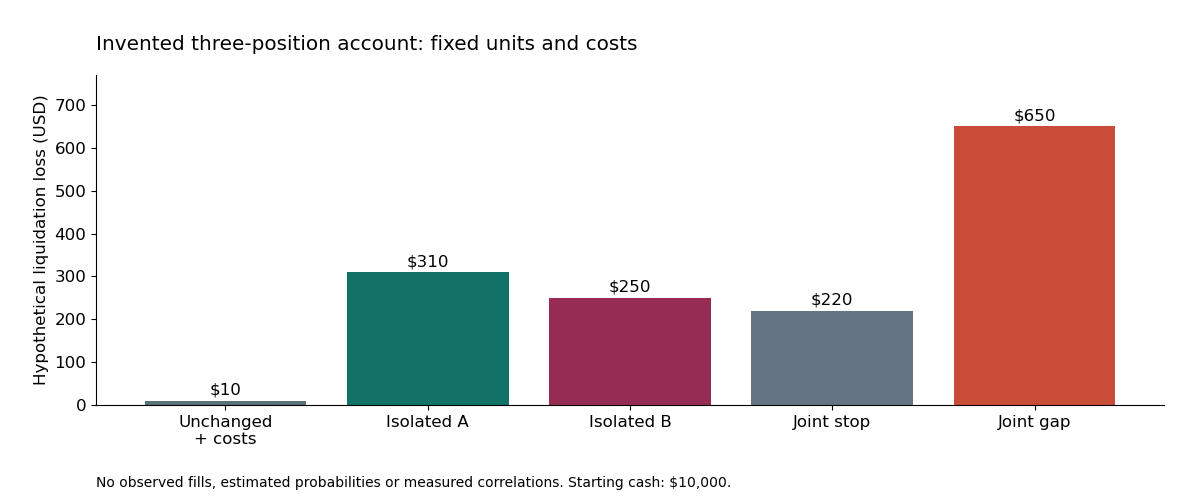
For the gap exits 94, 72 and 45, the corresponding losses are 305, 243 and 102, totalling 650. Dividing by the same 10,000 starting base gives 6.5%; terminal equity is 9,350 under full hypothetical liquidation. Interim marks are absent, so the percentage is not a measured maximum drawdown. It also contains no allowance for borrowing, tax, later price movement or costs omitted from the declared per-share convention.
Compare fixed assumptions without inventing likelihood
The unchanged-price row loses 10 because costs remain. Isolated A loses 310, and isolated B loses 250: the unshocked positions still pay their costs. The joint reference-stop row loses 220, while the deeper joint gap loses 650. Quantities, entry references and costs stay fixed across all five rows. None receives a probability weight. Isolated describes which prices change, not statistical independence; joint describes simultaneous assumed changes, not an estimated correlation coefficient.
An expected-loss calculation would need a justified mutually defined outcome distribution and weights. This table does not supply either. Adding the five losses would not produce expected loss or an actual equity path because the scenarios are alternatives, not consecutive trades. A changed account base must be recorded, and the funding check repeated. The exact funding boundary of 8,410 is accepted by this educational model, while 8,409 is rejected. That is a software boundary test, not broker authorisation.
What an independent arithmetic check does
The public JSON and CSV contain the same five rows. A Python Decimal reference calculates the cash amounts without importing the browser implementation. Browser fixture tests compare a grid of quantities, costs and exit prices, including a gain case. That checks arithmetic and input handling. It provides no independent validation of a trading entry model, exit strategy, market probability or real subscriber outcome. A result can be correctly computed and still have assumptions that do not describe an actual instrument.
For a real review, retain actual account marks and flows, settled resources, order versions, quantities, executions, applicable fees and the effective policy owner. Keep unfilled working orders distinct from holdings. A named missing source remains a missing source even when the specimen has a complete table. The original two-position worksheet and longer account protocols remain available below; this new record broadens the educational example without replacing their meaning or strengthening their assurance claims.
Filled position record
| Position | Shares | Entry | Reference stop | Gap exit | Extra cost / share | Funding USD | Planned loss USD | Gap loss USD |
|---|---|---|---|---|---|---|---|---|
| A | 50 | 100 | 98 | 94 | 0.1 | 5005 | 105 | 305 |
| B | 30 | 80 | 77 | 72 | 0.1 | 2403 | 93 | 243 |
| C | 20 | 50 | 49 | 45 | 0.1 | 1002 | 22 | 102 |
Alternative scenario records
| Scenario | A / B / C exits | Funding USD | Loss USD | Loss % of starting cash | Terminal equity USD |
|---|---|---|---|---|---|
| Unchanged prices, costs included | (100, 80, 50) | 8410.0 | 10.0 | 0.1 | 9990.0 |
| Isolated A shock | (94, 80, 50) | 8410.0 | 310.0 | 3.1 | 9690.0 |
| Isolated B shock | (100, 72, 50) | 8410.0 | 250.0 | 2.5 | 9750.0 |
| Joint reference-stop liquidation | (98, 77, 49) | 8410.0 | 220.0 | 2.2 | 9780.0 |
| Joint gap liquidation | (94, 72, 45) | 8410.0 | 650.0 | 6.5 | 9350.0 |
Reproducible specimen and retained tools
Download filled scenario CSV | Download filled scenario JSON