Two-position cash-funded gap stress
Compare planned stop-budget losses with two assumed exits for whole long shares. No correlation estimate or probability model.
Educational risk arithmetic, not personal sizing advice. Stops do not guarantee fills. Stress inputs are invented assumptions without assigned probabilities; margin, shorts and derivatives need their own contracts.
Read each position before the total
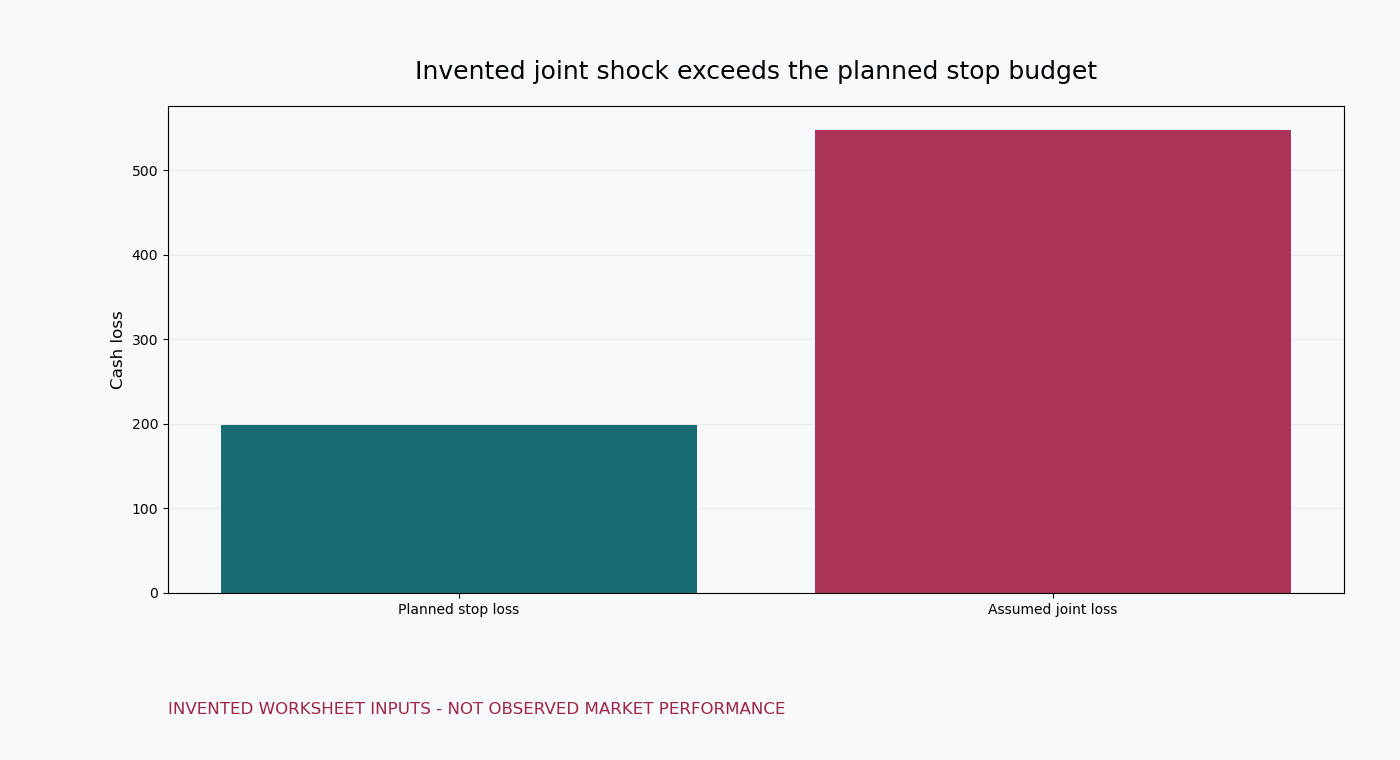
The invented A position is 50 shares entered at 100, stopped at 98 and assumed to exit at 94, with extra round-trip cost 0.10 per share. Planned loss is 105; scenario loss is 305. B is 30 shares at 80, stopped at 77, assumed exit 72 and cost 0.10: planned loss 93; scenario loss 243. Joint planned loss is 198; joint scenario loss is 548, or 5.48% of 10,000 cash.
Cash funding and units
Entry notional is 7,400 and additional costs are 8, giving funding of 7,408 in this conservative arithmetic. The tool rejects funding above entered account cash. Only non-negative whole shares and long-position prices with entry > stop > 0 are accepted; an assumed exit can be zero. All money uses one unspecified consistent currency. Cash settlement, broker eligibility and order availability are not checked.
This is not a tail-risk model
An assumed exit can be better or worse than the stop. A profitable position may offset another loss in the joint total; individual outputs remain visible. No scenario probability, live correlation, margin, short exposure, derivative multiplier, liquidity or guaranteed stop execution is modelled. Costs must be additional to the prices rather than counted twice.
Source documents
- Investor.gov brokerage account types
- Investor.gov order types
- FINRA current intraday trading information
Documentation establishes the stated mechanism, not tested trading performance. Checked 9 October 2026; a later version can differ.
Keep the original two-position contract
The earlier cash-funded A/B worksheet remains unchanged in its arithmetic and JSON shape. Its default planned loss is 198 and its joint scenario loss is 548 under explicitly hypothetical long-share exits and extra cost. A separate three-position worksheet adds C without replacing those rows or claiming they became observed trades. A negative scenario loss can mean an assumed gain rather than an error. Funding, costs and input validation stay explicit, and invalid entries do not export the last valid result.
A broader exercise without broader assurance
The new workbook compares isolated and joint shocks while retaining fixed quantities and a single USD cash base. It estimates no correlation, historical frequency or personal allocation. Both worksheets exclude shorts, leverage and derivatives from their long-share contract. A future actual account study would need the proper instrument units, orders, fills, financing and marks. A scenario percentage is not automatically a maximum drawdown, and an exact local calculation is not independent financial evidence merely because the page provides a downloadable JSON.