Account equity and marking frequency
Preserve open-position marks and observation clocks instead of measuring risk only from completed trades.
Balance and equity answer different questions
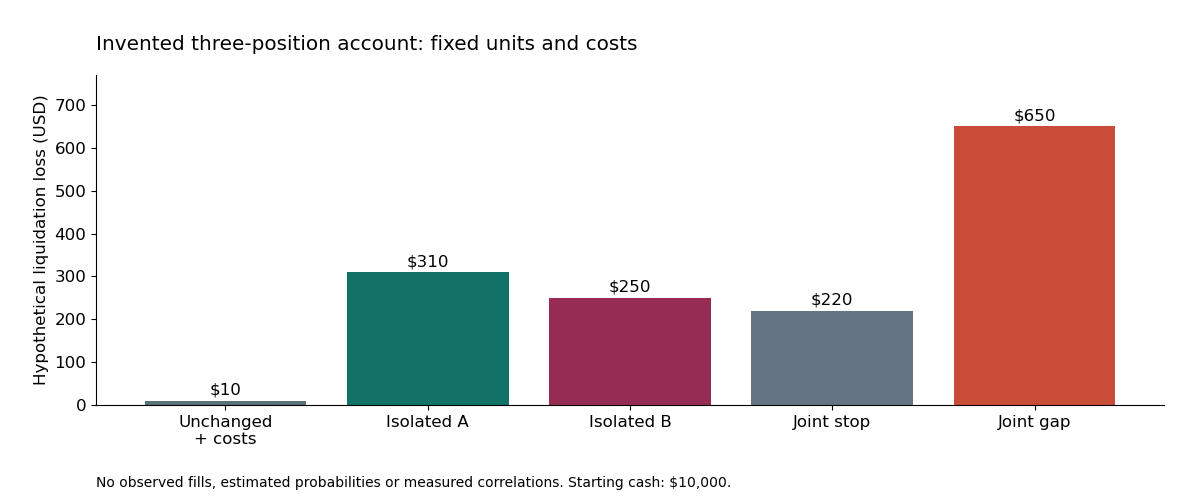
Closed account balance can omit open-position fluctuations. A marked equity record needs quantities, valuation sources, timestamps and treatment of costs or financing. A single final balance cannot reconstruct the worst point along a path. Define which object the drawdown calculation measures and preserve its source. The workbook provides terminal hypothetical liquidation results only. It contains no intraday marks, real position history or measured maximum drawdown, even when its loss is displayed as a percentage of a stated starting account.
Frequency changes what can be observed
Sparse observation can miss adverse movement between marks. That does not licence inventing a finer path from a final result. An actual risk measurement should state the available cadence, missing intervals and valuation convention. If only closed balance exists, label the finding accordingly instead of implying minute-by-minute account coverage. A completed-session clock does not automatically become daily stop ownership for a model. This educational release preserves native minute and whole-position exit semantics and creates no production monitor or workstation fallback.
Join flows and quantities
A deposit or withdrawal can change account resources while saying nothing about strategy performance. Record exact timing relative to marks and period boundaries. Open quantities and partial fills also need their own state so exposure is not calculated from a proposed full order. A source missing these objects can support a bounded observation but not a complete path audit. Do not fill missing equity marks with the most favourable hypothetical price or treat a higher ending balance as proof that an earlier loss was recovered through trading.
A practical source request
The final finding should identify whether the available record is closed balance, marked equity or a terminal scenario, and name the next missing observation. Correct drawdown arithmetic is useful only with the intended denominator and path. An independently tested account claim needs real sources, not a model summary or a local fixture. The workbench can preserve unresolved open-equity evidence without a numerical assurance score. Search and machine mirrors repeat these definitions so a terminal scenario is not silently promoted into a measured subscriber drawdown.
Completed invented account case
Fictional case: a record shows a start of 100 and an end of 90, but no intermediate marks. The reviewer can calculate a 10% start-to-end decline, not the maximum drawdown along an unknown path. The workbook's 650/10,000 ratio similarly describes a stated terminal loss rather than a measured path extreme. No actual account was inspected. The completed finding preserves the exact available calculation and requests marks before a stronger drawdown statement is made.
| Object | Record | Bounded finding |
|---|---|---|
| Available marks | Invented start 100 / end 90 | No interim path |
| Supported decline | 10% of start | Not maximum drawdown |
| Required record | Timestamped equity marks | No backfilled prices |
Primary references and scope
Expanded source review: 13 October 2026. Documentation supports the stated mechanism, not a tested account, hypothetical fill or provider outcome.