Correlation estimates versus stress assumptions
Do not turn an invented joint loss into a measured correlation or a diversification guarantee.
Measurement needs an information set
A correlation claim needs the paired observations, time alignment, sampling frequency, returns or other measured units, treatment of missing data and estimation period. Without those objects, a precise coefficient would be fabricated. A sample relationship is also different from a guaranteed future offset. The educational workbook provides none of those observations. It supplies deterministic exit assumptions only, so its isolated and joint labels should not be interpreted as statistically independent or correlated positions with measured probabilities.
Scenarios answer a different question
A scenario asks what cash result follows if specific assumed prices occur for fixed positions and costs. It can be reproduced without estimating the likelihood of that state. That is useful for identifying a consequence or a missing source record. A severe joint case does not prove that every relationship changes in a crisis, and a mild isolated case does not prove protection. Keep the cash formula and the statistical question in separate records instead of using one chart to answer both.
Avoid cancellation by convenient offsets
A gain in one assumed position can offset a loss in another arithmetically, but real timing, access, quantities, liquidity and contract terms still matter. Do not count a hypothetical hedge as fully effective simply because labels look opposite. If the source of an offset is absent, leave that claim unresolved. The new tool uses only cash-funded long shares and does not certify short hedges, leverage, options or dynamic rebalancing. Its default joint loss is not a probability-weighted portfolio statistic.
Write a bounded result
A completed finding can say that a specified portfolio loses a stated amount under one scenario, while covariance, tail dependence and actual exits remain unmeasured. A real statistical study needs a separate reproducible dataset and model. Software unit tests do not create that sample. The publication's primary links explain mechanism boundaries, not a current personal portfolio recommendation. The same limitation stays in JSON, CSV, figure captions and full-text machine material so an automated summary does not upgrade an invented example into empirical financial evidence.
Completed invented account case
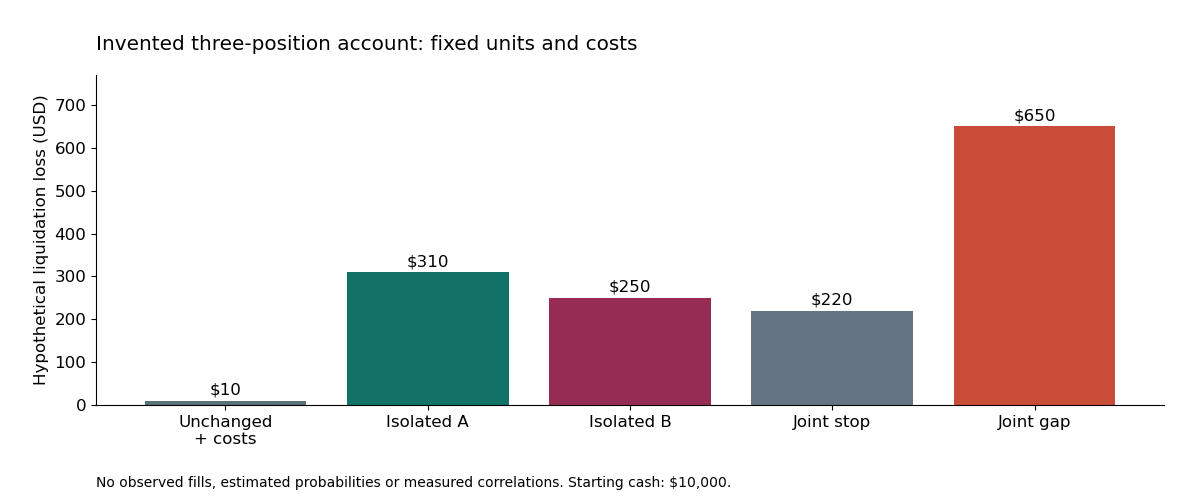
Fictional case: a reviewer sees the workbook's 650 joint gap loss and tries to label the positions fully correlated. The record has no paired returns or estimator, so that label is rejected. The 650 remains a valid deterministic scenario result under the entered long-share assumptions. No real market sample was fitted. The completed finding separates exact cash consequence from absent correlation measurement rather than weakening the useful arithmetic or inventing a coefficient to make the table look statistically sophisticated.
| Object | Record | Bounded finding |
|---|---|---|
| Available object | Invented exit scenario | Cash consequence reproducible |
| Missing object | Paired observation sample | Correlation unmeasured |
| Conclusion | 650 hypothetical loss | Not a diversification forecast |
Primary references and scope
Expanded source review: 13 October 2026. Documentation supports the stated mechanism, not a tested account, hypothetical fill or provider outcome.