Cost inclusion and double counting in risk scenarios
State which expenses are additional before combining entry-to-exit prices, per-unit costs and account totals.
Costs have units and timing
A per-share cost, per-order charge, recurring subscription and financing expense are different quantities. Keep the unit and observation period with the expense. The workbook takes a stated additional per-share round-trip assumption, reserves it under its funding convention and deducts it once from hypothetical liquidation outcomes. It is not a current broker tariff. If a real observed price or another calculation already includes a charge, adding it again can misstate the result. A precise cash number is useful only when its inclusion policy is clear.
Prices can already contain part of the effect
The actual entry and exit chosen for an account measurement should be documented fills, not a midpoint plus an invented spread correction unless the method explicitly uses such a hypothetical convention. Do not mix observed and theoretical prices without naming the difference. A fee record and a slippage scenario need separate source status. The publication supplies no real fills or quotes, so its prices and extra expenses are assumptions. This avoids claiming a tested realised P&L from inputs that merely resemble a plausible trade.
Keep unshocked positions visible
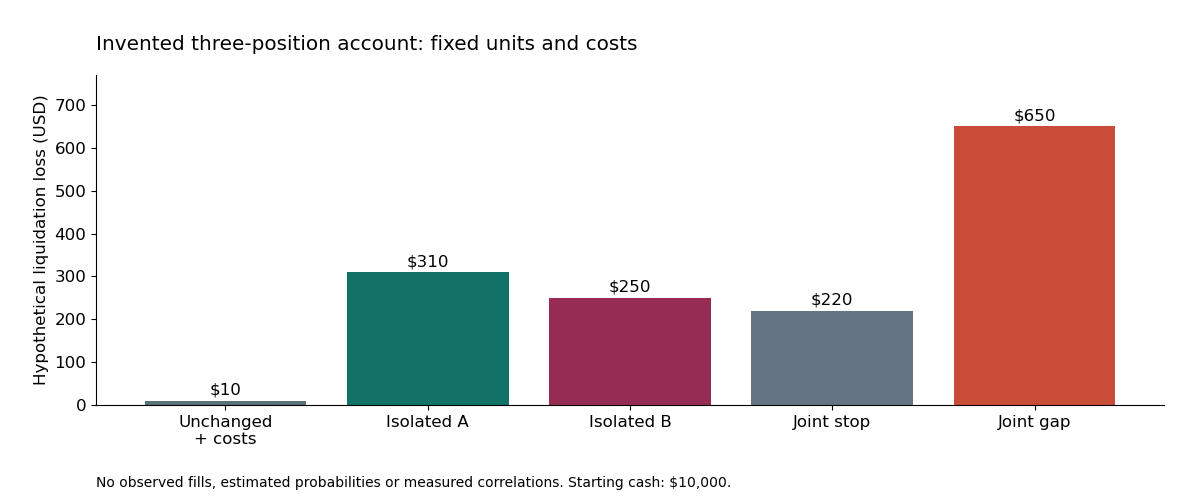
In an isolated price scenario, the other positions still follow the workbook's assumed full-liquidation and cost policy. Their unchanged prices do not make their costs vanish. With A/B/C fixed, unchanged-price loss is ten cash units solely from the entered additional expenses. Isolated A loss is 310, which includes costs on B and C. Those facts concern the invented contract, not the likelihood that all positions would really liquidate together. Preserve the convention before comparing a single-position chart with the account total.
A bounded correction
If an example counted an expense twice, correct the input or policy explicitly rather than silently improving a result. A real source claim requires the bill or account record appropriate to the charge. Current subscription catalogues can change and should not be guessed from old facts. The calculators do not select a checkout offer or a personal allocation. A completed method finding can show which buckets reconcile and which expenses remain unknown without inventing profitability, expected loss or a financially superior provider from a cheaper-looking assumption.
Completed invented account case
Fictional case: three positions total one hundred shares and each has an additional 0.10 expense. With unchanged exit prices, total liquidation loss is ten cash units, not zero. Isolated A's price move adds three hundred, so the account row is 310. There is no live tariff or actual fill. The completed record makes the one-time expense policy explicit and does not subtract that same ten again as a second fee bucket or assign a probability to the liquidation scenario.
| Object | Record | Bounded finding |
|---|---|---|
| Additional assumption | 100 shares x 0.10 | 10 cash, once |
| Unchanged exits | No price P&L | Costs still present |
| Isolated A | 300 price loss + 10 costs | 310 hypothetical total |
Primary references and scope
Expanded source review: 13 October 2026. Documentation supports the stated mechanism, not a tested account, hypothetical fill or provider outcome.