Funding cash and liquidation assumptions
Separate entry funding, reserved expenses and terminal scenario equity without inventing margin eligibility.
Funding has a contract
The three-position tool assumes cash-funded USD long shares. Entry quantities multiplied by entries plus the stated additional per-share expenses must fit inside the starting cash base. This is an explicit conservative reservation convention for the illustration, not a broker financing quote. Actual expenses may occur at different times and need their own record. A funded example can still suffer a large adverse price move. Do not use acceptance of the form as proof of margin eligibility, personal suitability or limited loss.
Terminal liquidation is an assumption
The workbook assumes every included share is liquidated at its row's exit price and incurs the entered additional cost. It does not observe an order or guarantee all units can exit together. Under that convention, starting cash minus net liquidation loss gives terminal account equity. A gain can appear as negative loss and should not be clamped away. A price mark without a sale would need a different accounting interpretation. Keep the exact convention rather than labelling every cash result realised profit.
Other account types need their own source
Futures margin and securities borrowing are mechanisms with specific terms and cannot be silently inserted into this cash lane. Current broker requirements, house changes, collateral and liquidation rights need dated account evidence. CME's public education provides background, not the reader's actual schedule. A stop-price loss and funding requirement are different quantities. When the account contract is absent, the financing finding stays unresolved even if a simple position formula can be reproduced correctly.
A bounded comparison
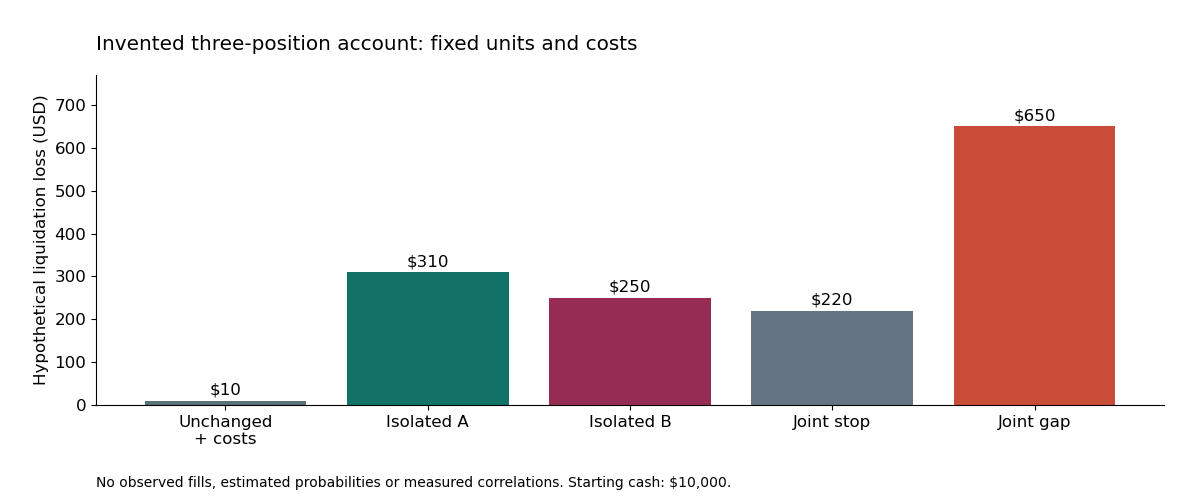
The specimen fixes 10,000 starting cash and uses 8,410 under its entry-plus-cost convention. It compares five hypothetical full exits without interim flows. Actual taxes, financing, conversions, partial fills and liquidity are excluded. A complete consumer record should state those omissions rather than treating a narrow calculation as a universal portfolio risk system. The original two-position worksheet remains intact, and the new three-position output is labelled an arithmetic assumption record rather than observed subscriber performance or an instruction to deploy capital.
Completed invented account case
Fictional case: A/B/C require 8,410 under the stated entry and additional-cost reservation. Starting cash of 8,409 is rejected; 8,410 meets that funding check. The joint gap still produces a hypothetical 650 loss. No margin account or broker requirement is represented. The completed finding is funded within the defined cash illustration, not safe from a gap or eligible for a leveraged contract. A different actual account would require its own terms and evidence.
| Object | Record | Bounded finding |
|---|---|---|
| Entry plus costs | Invented 8,410 | Explicit reservation convention |
| Starting cash 8,409 | Insufficient | No export |
| Starting cash 8,410 | Funding check met | Not a loss guarantee |
Primary references and scope
Expanded source review: 13 October 2026. Documentation supports the stated mechanism, not a tested account, hypothetical fill or provider outcome.