Shared factors and joint-shock records
Describe a common event and fixed position set before comparing isolated and joint portfolio stress.
Different labels are not independence
A portfolio can contain different instrument labels while depending on a common event or exposure. Identify the factor relevant to the question rather than counting symbols as independent bets. That observation does not establish a numerical correlation; such a measurement requires a defined sample and units. A consumer scenario can deliberately change several assumed prices together without claiming it measured a historical relationship. Keep the scenario assumption separate from an empirical dependence estimate and preserve the source of any stronger claim.
Freeze positions and costs
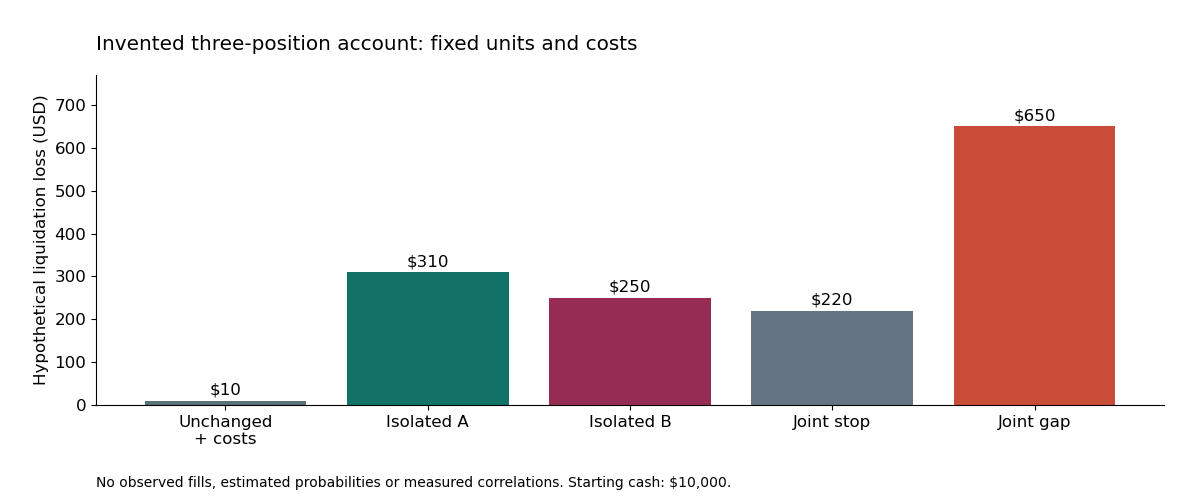
The workbook holds quantities, entries and additional costs fixed across its five rows. Isolated A and B cases change only the selected assumed price, while the joint cases change several. Unshocked positions still incur the declared hypothetical liquidation costs. Changing quantity or fee treatment after seeing a loss would invalidate the intended comparison. A fixed cash-funded portfolio can therefore show exactly which price assumptions change the result while leaving occurrence probability, financing and real liquidity untested.
Name the common event cautiously
In a real review, a factor map should identify the exposure and period that could make positions respond together. A familiar sector label is not complete evidence of the account's actual quantities or response. A risk exercise can keep an event definition hypothetical and still be useful. Do not invent a crisis frequency or declare all relationships collapse under stress. The next evidence might be account holdings, source returns, currency treatment or an observed exit path, depending on the claim.
Separate terminal cash from path risk
The workbook computes full hypothetical liquidation at entered exit prices. It supplies no sequence of price moves, funding calls or intermediate equity marks. A terminal loss therefore is not automatically maximum drawdown, liquidation timing or a guaranteed worst case. The consumer finding should state the fixed positions, cash denominator, costs and assumed exits. Actual account controls need their own owner and effective policy. A source summary or grade cannot fill those missing records, and correct scenario arithmetic is not independent strategy validation.
Completed invented account case
Fictional case: A, B and C share an assumed event in one workbook row. The joint gap gives a 650 cash loss; the isolated A case gives 310 with all liquidation costs retained. No covariance or probability is estimated. The positions are invented USD long shares, not real holdings. The completed comparison shows the effect of the specified joint price assumptions while leaving historical dependence and actual exit availability unresolved. It does not recommend changing a personal portfolio based on those numbers.
| Object | Record | Bounded finding |
|---|---|---|
| Fixed positions | A/B/C invented long shares | Same quantities across rows |
| Isolated A / joint gap | 310 / 650 cash | Assumed exits, all costs |
| Dependence finding | Not estimated | No probability or covariance |
Primary references and scope
Expanded source review: 13 October 2026. Documentation supports the stated mechanism, not a tested account, hypothetical fill or provider outcome.